The Courtesan in Cinema — Why She's Always the Most Powerful Woman in the Room
The Villain Aesthetic · Cinema Psychology
The Courtesan
in Cinema —
Why She's Always the Most
Powerful Woman in the Room
She holds no throne. She commands no army. Yet when she enters, every conversation shifts.
Imagine a hall filled with kings. Their turbans carry the weight of dynasties. Generals stand with empires behind them. Merchants calculate the price of everything. A nawab reclines, bored by the size of his own fortune.
Then she enters.
Not loudly. Not with a declaration of power. She enters like a line of poetry spoken into a room that has forgotten what poetry is. And every eye in the hall — every eye belonging to every man with land and money and armies — follows her.
Ask yourself: why? These men hold formal power. She holds nothing formal at all. Yet in every moment she is in that room, she is somehow the one who understands it best. That asymmetry — between who holds power and who understands power — is what the courtesan archetype has always been about.

The space between glamour and confinement — where the courtesan archetype has always lived. Still from the visual grammar of classic Bollywood cinema.
Section One
What Is the Courtesan Archetype?
The courtesan archetype exists in almost every storytelling tradition that has ever grappled seriously with the question of women and social power. She appears in the tawaif culture of Mughal and pre-Partition India. She surfaces in the geisha narratives of Japanese literature, the hetaira of ancient Greece, the courtesans of European royal courts, the poetic imagination of Persian ghazals, the salons of revolutionary France. Across all these traditions, a consistent figure emerges: a woman of extraordinary social intelligence, refined cultural skill, and navigational wisdom — who nevertheless exists outside the official social order.
Before we proceed, a distinction must be made — one that cinema does not always honour, but that intellectual honesty requires. The historical reality of these women's lives involved systemic coercion, inherited poverty, and brutal social exclusion. Many tawaifs were not choosing their fate; they were born into it, or sold into it, or driven into it by famine, widowhood, or caste violence. The cinematic archetype and the historical reality are not the same thing, and it would be intellectually dishonest — as well as morally careless — to treat one as the other.
What cinema has consistently done, at its most thoughtful, is use the formal elements of this archetype — the intelligence, the performance skill, the social exclusion, the intimate knowledge of power — to explore questions that polite society refuses to ask directly. Questions about who really understands power. About the cost of desire. About what refinement means when it is used as a survival mechanism. About what it means to be seen and never quite known.
Section Two
Power Without Authority
There is a difference between power and authority that political philosophy has always known but popular culture frequently collapses. Authority is institutional — it is granted, inherited, and enforced. A general has authority over his troops not because his personality compels them but because a structure places him above them. A nawab commands obedience not because he has earned it individually but because he was born into a position that demands it.
Influence, by contrast, is personal and social. It is the capacity to shape what people think, want, decide, and remember. Influence operates through perception, through desire, through the management of attention. And here is the structural irony that the courtesan archetype embodies so precisely: the person with the most formal authority often has the least need to develop real social intelligence. Power insulates you from having to understand people. You can simply command them.
The courtesan has no such insulation. She must understand everyone in the room perfectly, continuously, in real time. Her survival depends not on the exercise of authority but on the perfect reading of those who have it. She learns to detect the exact frequency on which a man's pride vibrates. She understands what he needs to feel about himself before he can feel anything else. She knows the difference between vanity and genuine loneliness — and she knows how to respond to each.
"The person with the most formal authority often has the least need to develop real social intelligence. Power insulates you from having to understand people."
The Villain Aesthetic — Cinema Psychology
The Structural Contrast — Influence vs. Authority
Influence
Section Three
Why These Characters Understand People So Well
Psychological literature on acute social perception consistently points to the same condition that produces it: asymmetric stakes. When a person's wellbeing depends entirely on correctly reading the emotional state and intentions of someone who holds power over them, the brain's social processing systems undergo a kind of forced development. Psychologist Susan Fiske's research on power asymmetry demonstrates that lower-power individuals consistently show higher accuracy in reading the emotions of higher-power individuals — not because of some innate sensitivity, but because their survival depends on it.
The courtesan archetype in cinema embodies this dynamic almost architecturally. She observes with the precision of someone for whom observation is not a hobby but a necessity. She notices the flicker of irritation that appears three seconds before a man consciously feels irritated. She reads the way a general's posture changes when a particular subject is raised. She understands — before he does — exactly how much of what he feels for her is desire and how much is the desire to feel powerful in her presence.
This is not manipulation, though cinema often codes it as such. It is the highest form of social perception: the ability to see people as they actually are, beneath the roles they perform. And there is a profound sadness embedded in this gift. She sees them clearly. She is rarely, if ever, seen clearly in return.
Psychology Insight
The Asymmetric Attention Phenomenon
Research by Fiske et al. in social cognitive psychology establishes that individuals in low-power positions develop markedly superior skills in reading emotional cues and inferring intentions — simply because the cost of misreading is far higher for them. The courtesan archetype maps onto this finding with unusual precision: her social intelligence is not a romantic gift; it is an adaptation. The same intelligence that cinema depicts as making her fascinating and powerful is the direct product of her structural vulnerability. The tragedy and the brilliance are the same thing.
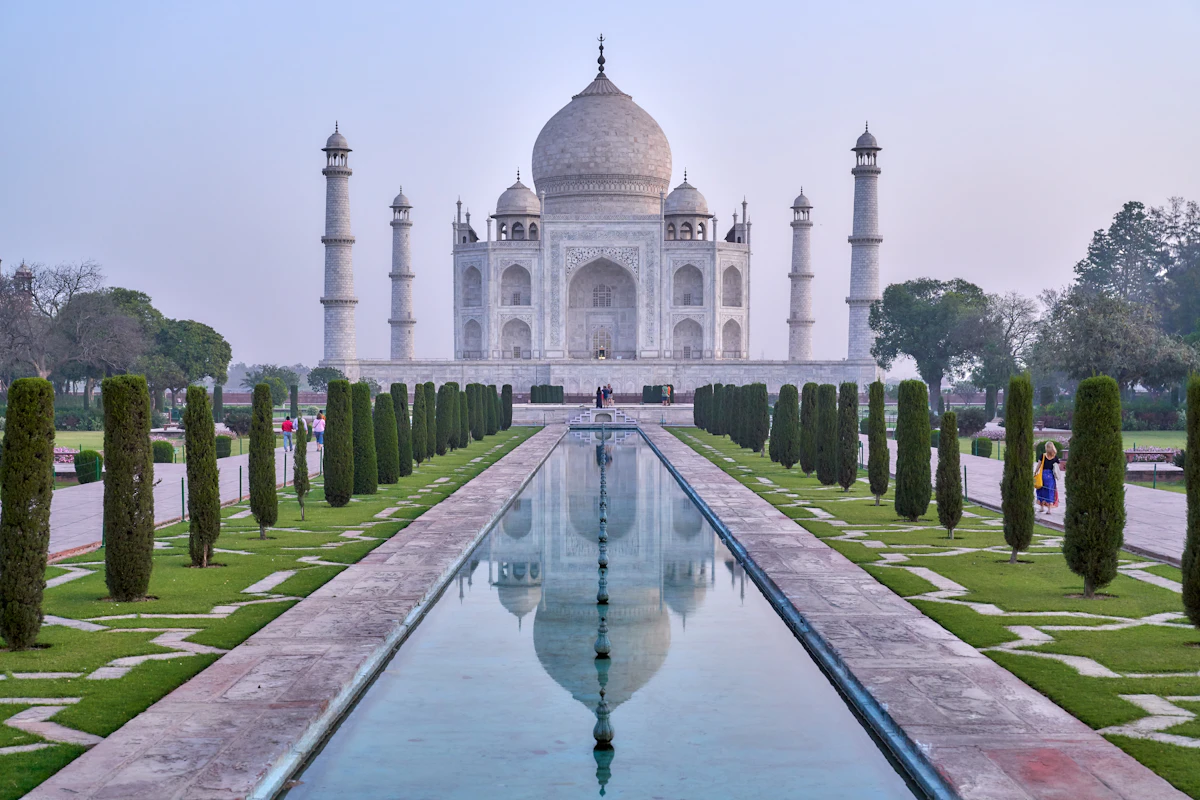
The architecture of power — haveli corridors, carved jali screens, curtained antechambers. The courtesan knew these spaces more intimately than the men who owned them.
Section Four
Performance as Power
The courtesan's art forms — classical dance, Thumri, Ghazal, Kathak, refined conversation — are not mere entertainment in the cinematic imagination. They function as the primary language through which she exercises agency in a world that denies her most other forms of it. When cinema depicts a courtesan performing, it is almost always charged with a secondary meaning: she is not just dancing or singing, she is speaking. In a language that the audience understands and that the powerful men in the room can hear only partially.
Consider what a Ghazal actually is, structurally. The ghazal form operates through layered metaphor — the beloved is simultaneously a person, a divine principle, and an impossible ideal. Its poetic grammar is inherently ambiguous, and that ambiguity is not a flaw but a feature. When Umrao Jaan recites poetry in Muzaffar Ali's 1981 film, she is not simply performing for an audience; she is encoding her interiority in a form that gives her complete plausible deniability. She can say everything she truly thinks and feels while maintaining the performance that the social structure requires. The poetry is a kind of sovereign inner space.
Dance operates similarly. Kathak, the classical form most associated with the tawaif tradition, is technically extraordinary — demanding years of disciplined training in rhythmic complexity, expressive gesture, and footwork that carries its own kinetic intelligence. When Sahib Jan dances in Pakeezah, she is not simply being beautiful. She is demonstrating a mastery of form so complete that it constitutes a statement: I have made something of myself that no social condition can unmake.
"Poetry was a sovereign inner space. She could say everything she truly felt while maintaining the performance the social structure required."
The Villain Aesthetic — Cinema Psychology
Section Five
The Courtesan and the Politics of Desire
Desire, in almost every social hierarchy ever constructed, is a form of currency. The person who is desired holds something the desirer needs — and that need, however briefly, redistributes power. This is the most uncomfortable truth that the courtesan archetype forces a narrative to confront: the system of desire that powerful men use to access her also gives her access to them. Not equally. Not safely. But genuinely.
What cinema explores so intelligently through this archetype is the way desire destabilises the hierarchies that men construct to manage it. A general who desires her must, for the duration of that desire, become vulnerable in a way his rank never allows him to be in public. He must want something he cannot simply command. And in that wanting, she sees the gap between who he performs himself to be — the powerful, controlled, aristocratic figure — and who he actually is: a man who needs something, who can be moved, who can be made to feel.
The most sophisticated cinematic treatments of this dynamic — and both Pakeezah and Umrao Jaan qualify — refuse to make this a story of simple reversal, where the marginalized woman gets her revenge through the power of desire. Instead, they show the ambivalence of this position clearly: to be desired is not to be safe. To be needed is not to be valued. To understand people better than they understand themselves is a form of profound isolation, not triumph.

Classical dance as the language of interiority — for the courtesan archetype, performance was never only entertainment. It was the only space in which she was truly sovereign.
Section Six — Case Study
Pakeezah (1972) — The Pure Heart in an Impure World
Character Profile
Sahib Jan / Pakeezah
Pakeezah (1972) — Dir. Kamal Amrohi · Performed by Meena Kumari
Kamal Amrohi began shooting Pakeezah in 1958. He completed it in 1972 — fourteen years during which his marriage to Meena Kumari collapsed, and the film itself became something beyond cinema: a document of longing so sustained that it achieved the quality of a ruin preserved in amber. What the film ultimately portrays in Sahib Jan is not a tawaif's life as it was, but desire for respectability as an emotion so profound and so impossible that it becomes its own form of tragedy.
The film's central visual grammar — white clothes against crimson rooms, glass anklets on feet that may never touch clean earth, the famous train note — is the visual grammar of purity trapped in contamination. But what makes Pakeezah psychologically profound is its understanding that Sahib Jan's tragedy is not simply that she is denied dignity by society; it is that she has internalised that denial so completely that she cannot recognise it when it is genuinely offered. She has learned not to trust the possibility of being seen as pure. That learned untrustworthiness — the inability to receive the thing you most desire — is the film's most devastating insight.
"Aapke paon dekhe, bahut haseen hain. Inhe zameen par mat utariyega, maile ho jaayenge." — The anonymous note that begins everything, and says everything.
Pakeezah's visual poetry is inseparable from its psychological content. The film's costume palette — whites, creams, and pale rose against the deep reds and burgundies of the kotha — is not mere aesthetics. It is the visual argument of the film: that innocence and contamination have been forced into the same body, and that the tragedy is not having to choose between them but being denied the freedom to choose at all. Sahib Jan is always dressed in the colours of purity. She is never allowed to inhabit purity's social meaning.
In this sense, Meena Kumari's performance — her final significant screen appearance before her death the same year the film released — achieves something extraordinary. She plays Sahib Jan with a quality of longing so contained, so refined, so tightly held within classical feminine restraint, that it feels less like acting and more like revelation. Every viewer who watches Inhi Logon Ne understands, without needing to be told, that this is a woman who has been managing grief so long it has become indistinguishable from her personality. That is the specific psychological truth of the archetype at its most honest: grief worn so long it becomes grace.
Section Seven — Case Study
Umrao Jaan (1981) — Intelligence as the Final Freedom
Character Profile
Umrao Jaan Ada
Umrao Jaan (1981) — Dir. Muzaffar Ali · Performed by Rekha · Based on Mirza Hadi Ruswa's 1899 novel
If Pakeezah is a poem, Umrao Jaan is an autobiography — and that distinction matters enormously to how each film constructs its central character's relationship to self-knowledge. Mirza Hadi Ruswa's 1899 Urdu novel Umrao Jaan Ada, on which the film is based, is remarkable precisely because it is presented as Umrao's own narration of her life. She is not an object being observed; she is a consciousness describing its own experience with extraordinary lucidity and without self-pity.
Rekha's performance in Muzaffar Ali's film carries this quality of internal clarity throughout. What she plays is not tragic victimhood but something more complex and more dignified: a woman of genuine intellectual and artistic achievement who is never allowed to translate that achievement into social belonging. Her poetry is not a consolation prize for a life she couldn't have; it is a genuinely sophisticated artistic output, composed by someone who understands feeling, form, and language with rare precision. The tragedy is not that she failed to become a respectable woman. The tragedy is that respectability was the only success the society she lived in could recognise.
"Yeh kya jagah hai doston, yeh kaunsa dayar hai / Hadh-e-nigah tak yahan dust-o-ghubar hai" — Umrao Jaan's most famous ghazal, written in exile, is a landscape of dust and grief and permanent displacement.

The face as archive — in both Pakeezah and Umrao Jaan, the camera treats the face as a document of everything the social world refused to record.
What Muzaffar Ali's film understands about Umrao Jaan — and this is the insight that separates it from simpler treatments of the same archetype — is that her intelligence is her true identity, not her profession. She is a poet who was forced by circumstance into a professional context that society then used to dismiss her poetry. The cruelest thing the world does to Umrao Jaan is not what it makes her do; it is what it refuses to see in her. Her cultural refinement — her Urdu, her ghazals, her mastery of classical music — places her in conversation with the finest minds of her era. But the room she occupies socially places her forever outside the circle of those whose cultural production is taken seriously.
This specific form of erasure — the erasure of intellectual and artistic achievement by social categorisation — is what makes Umrao Jaan a figure of enduring resonance. Her story is not merely a historical curiosity about a specific social institution. It is a universally legible story about how societies decide whose contributions count and whose do not.
Section Eight
Why Cinema Loves This Archetype
Cinema as a storytelling form has always been drawn to figures who live at the intersection of contradictions — characters whose inner reality is in profound tension with their social presentation. The courtesan archetype provides this intersection in almost perfect form. She is simultaneously refined and marginalised, seen and unseen, powerful and powerless, desired and disposable. Almost every quality that makes her cinematically compelling emerges from this central structural contradiction.
There is also a specifically visual logic to cinema's attraction to this archetype. The art forms associated with the tawaif — Kathak, ghazal, elaborate costuming, the staging of the kotha — are enormously photogenic in the most fundamental sense: they were designed to be seen, to create visual experience, to arrange beauty in space. They translate to cinema with an almost uncanny naturalness, because they were themselves already a form of precisely crafted performance designed for an intimate audience.
And then there is the matter of emotional complexity. Mainstream cinema — particularly the commercial mainstream — is frequently uncomfortable with female characters whose inner life cannot be resolved into a simple emotional register. The courtesan, in her best cinematic treatments, refuses that simplification completely. She is at once knowing and innocent, complicit and trapped, joyful and grieving. She is the character who cannot be summarised. And cinema, at its most ambitious, has always been drawn to characters who cannot be summarised.
Psychology Insight
The Magnetism of Unresolvable Contradiction
Narrative psychology research consistently shows that audiences form the deepest attachments to characters whose emotional state cannot be cleanly categorised — characters who are simultaneously one thing and its opposite. The technical term is "affective complexity." The courtesan archetype in cinema generates extraordinarily high affective complexity by design: she is simultaneously insider and outsider, powerful and powerless, celebrated and excluded. This complexity is not a byproduct of sophisticated storytelling; it is the product of the archetype's structural position. She IS the contradiction. That is why she is so difficult to look away from — and so difficult to reduce.
Section Nine
The Difference Between Influence and Power
The courtesan archetype forces cinema to make a distinction that most stories are happy to leave blurred: the distinction between changing the outcome of a specific event and changing how someone sees the world. Authority achieves the former routinely and the latter almost never. Influence achieves the latter, sometimes, and remains structurally unable to guarantee the former.
A nawab in the world of Pakeezah or Umrao Jaan can command armies, transfer property, determine who eats and who starves. What he cannot command is the quality of his own inner experience — what he actually feels, what he carries with him after the encounter ends, what he thinks about in the quiet hours. That inner territory is precisely where the courtesan operates. She does not control his decisions. She shapes his memories. And memories, as every psychological account of human motivation confirms, are ultimately more powerful determinants of behaviour than formal commands.
This is the influence the archetype embodies: not the power to redirect armies but the power to live permanently inside someone's emotional landscape. It is a form of power that leaves no institutional trace. It cannot be pointed to in a legal document or a military record. It is felt, not filed. And for exactly that reason, it has historically been dismissed by the systems that prefer power to be legible, countable, and controllable.
Section Ten
The Courtesan as a Symbol
At the level of cultural symbolism, the courtesan archetype carries a burden of meaning that extends well beyond her individual story. She is simultaneously a symbol of beauty and a symbol of the social conditions that commodify beauty. She is the embodiment of cultural refinement in a world that produces refinement and then disqualifies its producers from its rewards. She is freedom and confinement in a single body — trained to perform freedom, permanently constrained in fact.
In the context of Indian cinema specifically, the tawaif figure carries additional layers of historical symbolism. She was historically one of the primary preservers of classical Urdu literary culture, Kathak dance tradition, and Hindustani classical music at a time when these art forms were not institutionally supported. The courtesans of Lucknow and Delhi maintained schools of classical music and poetry at a moment in the nineteenth century when aristocratic patronage was collapsing under colonial economic pressure. The historical irony — that the social group most stigmatised was simultaneously the most significant cultural custodian — is not lost on the best cinematic treatments of the archetype.
This is the symbolic weight that makes the courtesan archetype in cinema feel so much larger than any individual story. She is not only a woman in a specific set of social circumstances. She is the emblem of every cultural contribution that a society has chosen to consume without choosing to honour.
"She was the emblem of every cultural contribution that a society has chosen to consume without choosing to honour."
The Villain Aesthetic — Cinema Psychology

Cinema is the medium through which the courtesan archetype passes from historical fact into cultural mythology — gaining in symbolic density what it sometimes loses in historical accuracy.
Section Eleven
Modern Versions of the Archetype
The tawaif as a historical institution has dissolved. But the archetype — the socially marginalised woman of extraordinary social intelligence and cultural refinement, who understands power better than those who possess it — has not dissolved. It has migrated. It surfaces in contemporary cinema in forms that the original archetype would not recognise literally, but would recognise structurally.
The elements travel with remarkable consistency: a woman whose insight exceeds her social position, whose emotional intelligence is a product of necessity rather than privilege, whose art or skill is the primary language through which she claims sovereignty over her own interiority, whose understanding of the powerful people around her is uncomfortably accurate, and whose tragedy is not that she lacks quality but that the systems around her lack the capacity to recognise it.
Devdas (2002)
Chandramukhi — Madhuri Dixit
The tawaif who sees Devdas with perfect clarity while Paro sees only the man she needs him to be. Her insight is the film's moral compass — and its most undervalued element.
Bajirao Mastani (2015)
Mastani — Deepika Padukone
Not a courtesan by profession, but structurally an outsider whose refinement, intelligence and emotional clarity are used by the social order around her and then refused legitimacy.
Moulin Rouge! (2001)
Satine — Nicole Kidman
A Western reworking of the archetype that understands the symbolic logic even while aestheticising it — the woman who performs desire for an audience that needs her to, while harbouring an entirely different inner life.
Gangubai Kathiawadi (2022)
Gangubai — Alia Bhatt
Perhaps the most politically direct modern treatment — a woman who converts the social intelligence of marginalisation into actual political agency, challenging the archetype's tragic limitations.
Section Twelve
Conclusion — The Most Powerful Person in the Room
"The most powerful characters in cinema are not always the ones giving orders. Sometimes they are the ones who understand people best."
There is a scene near the end of Umrao Jaan's life as the film imagines it — or near the end of Sahib Jan's dignity as Pakeezah constructs it — where you understand, with sudden and absolute clarity, that you have been watching the most intelligent person in every scene she has occupied. She knew what everyone around her wanted. She understood what each of them was performing and why. She saw the gaps between who they claimed to be and who they actually were. She held this knowledge with enormous grace, and it protected her not at all.
That gap — between understanding and safety, between insight and institutional recognition, between influence and authority — is what the courtesan archetype, at its most honest, has always been about. Cinema returns to this figure not out of nostalgia or prurience but because she embodies a question that every audience secretly asks: what does it mean to understand people perfectly, and be understood by almost no one?
The answer, as Pakeezah and Umrao Jaan and every serious treatment of the archetype suggests, is this: it means you were brilliant, and the world was not yet ready to be honest about what it owed you. The most powerful woman in the room is often the one who leaves it changed, while it leaves her unchanged. That is the tragedy. That is also — quietly, persistently — the power.
Comments
Post a Comment